Saturday, 31 August 2013
August 2013
Note from Andrew Beach - Pat's Husband: I regret to say that my
beloved wife passed away in November 2013. As you will know if you have
read her blog posts she was truly in love with nature and enjoyed
sharing this love with others through these posts. This post was
prepared but not published which I now do in her memory. It may not be
complete but this is how she left it, so how it shall be.
1st Hottest day of the year so far- in the low 30's
2nd Lots of butterflies in the garden - mainly whites but also a comma, a peacock and a small blue. Damsel flies also fly around and a large brown dragonfly zooms through.
5th Sunshine and showers today with lots of birds in the garden-sparrows, blue tits, great tits, a coletit, blackbirds and a young and adult robin - so I guess its only a matter of time when all this activity would attract a sparrowhawk. He sits on the fence and is empty handed. He flys off as I reach for the camera. I wait to see which birds come back and I'm surprised as a female woodpecker arrives on the feeders. She is replaced by a blackbird then bluetits ,great tits, sparrows, a coletit and pigeons.
Wed 14th August Start of our trip to Skye.
Overnight stay at Wyreside Lakes, Lancaster. Rain through the night. Swaths of purple/pink rosebay willow herb line our route up the motorway.
Thursday 15th -18th Copeland Campsite, Stirlingshire. Forest Site.
We find quiet pitch. Some rain over night but Friday starts sunny. On a ride out we find a lovely waterfall were I think fairies could live amongst the flowers, ferns and moss. Swallows and pied wagtails fly around and chaffinch look for food by the tables.
On the way back we spot Red Deer. It looks like they are in someones back garden.
Red deer ( Cervus elaphus) There are more than a quarter of a million red deer in Scotland. Red deer stags live separate groups to the females except in the rutting season. They feed on grasses, heather and lichens. In summer the coat is brighter and goes grey -brown from September. at the start of the rutting season. Stags are in their prime and try to round up as many hinds as possible. They bellow and thrash trees to show their strength. If nessasary they fight with their antlers some will be injured but some will be killed. The most successfull stags are around 8 years old and hold a harem of 10 - 20 hinds. The farming of red deer has become widespread due to their low-cholesterol venison.
Sat 17th Rain all morning but the sun came out about 1ish. Id given up on anything comung to my bird feeder when a cole tit arrives, then 2 bluetits and a great tit. Three chaffinch try to land but they are ground feeders so fly away. The leaves on the ground are moving so I wait to see what will appear and finally a mouse comes out into the open.
Sun18th Travelling to Skye through Glen Coe which is still a beautiful place in spite of the rain and wind. We arrive safely and set up camp. What a view!!
We are on the waters edge of Loch na Cairidh opposite the Isle of Scalpay. That evening we see red deer on the shore line of Scalpay.
19th Rain and wind in the night but the sun is now trying to break through. Herons, gulls, terns, oystercatchers and a hooded crow are feeding in the seaweed.
Hooded crow (Corus cornix) The Hooded crow has a black head, wings and tail with a grey-pinkish body and a black bib. It feeds on the ground where it hops or walks eating carrion, young birds, mammals, eggs, insects and other invertebrates. They will also eat seeds, fruit and grain. It lives anywhere it can explote a food source.
I take a walk along the jetty and take pictures of starfish
seaweed,
and a crab.
Back at the van I see my main reason for coming to Skye -A White Tailed Sea Eagle wow !! It flys down to steal a fish from the gulls and flys off with his catch over to Scalpay where it disappears over the mountain.
White Tailed Sea Eagle (Haliaeetus albicilia) Heavier and bulkier than the golden eagle with broad wings and 'fingered tips' , a short wedge shaped white tail, a strong neck and a powerful bill.
1st Hottest day of the year so far- in the low 30's
2nd Lots of butterflies in the garden - mainly whites but also a comma, a peacock and a small blue. Damsel flies also fly around and a large brown dragonfly zooms through.
5th Sunshine and showers today with lots of birds in the garden-sparrows, blue tits, great tits, a coletit, blackbirds and a young and adult robin - so I guess its only a matter of time when all this activity would attract a sparrowhawk. He sits on the fence and is empty handed. He flys off as I reach for the camera. I wait to see which birds come back and I'm surprised as a female woodpecker arrives on the feeders. She is replaced by a blackbird then bluetits ,great tits, sparrows, a coletit and pigeons.
Wed 14th August Start of our trip to Skye.
Overnight stay at Wyreside Lakes, Lancaster. Rain through the night. Swaths of purple/pink rosebay willow herb line our route up the motorway.
Thursday 15th -18th Copeland Campsite, Stirlingshire. Forest Site.
We find quiet pitch. Some rain over night but Friday starts sunny. On a ride out we find a lovely waterfall were I think fairies could live amongst the flowers, ferns and moss. Swallows and pied wagtails fly around and chaffinch look for food by the tables.
On the way back we spot Red Deer. It looks like they are in someones back garden.
Red deer ( Cervus elaphus) There are more than a quarter of a million red deer in Scotland. Red deer stags live separate groups to the females except in the rutting season. They feed on grasses, heather and lichens. In summer the coat is brighter and goes grey -brown from September. at the start of the rutting season. Stags are in their prime and try to round up as many hinds as possible. They bellow and thrash trees to show their strength. If nessasary they fight with their antlers some will be injured but some will be killed. The most successfull stags are around 8 years old and hold a harem of 10 - 20 hinds. The farming of red deer has become widespread due to their low-cholesterol venison.
Sat 17th Rain all morning but the sun came out about 1ish. Id given up on anything comung to my bird feeder when a cole tit arrives, then 2 bluetits and a great tit. Three chaffinch try to land but they are ground feeders so fly away. The leaves on the ground are moving so I wait to see what will appear and finally a mouse comes out into the open.
Sun18th Travelling to Skye through Glen Coe which is still a beautiful place in spite of the rain and wind. We arrive safely and set up camp. What a view!!
We are on the waters edge of Loch na Cairidh opposite the Isle of Scalpay. That evening we see red deer on the shore line of Scalpay.
19th Rain and wind in the night but the sun is now trying to break through. Herons, gulls, terns, oystercatchers and a hooded crow are feeding in the seaweed.
Hooded crow (Corus cornix) The Hooded crow has a black head, wings and tail with a grey-pinkish body and a black bib. It feeds on the ground where it hops or walks eating carrion, young birds, mammals, eggs, insects and other invertebrates. They will also eat seeds, fruit and grain. It lives anywhere it can explote a food source.
I take a walk along the jetty and take pictures of starfish
seaweed,
and a crab.
Back at the van I see my main reason for coming to Skye -A White Tailed Sea Eagle wow !! It flys down to steal a fish from the gulls and flys off with his catch over to Scalpay where it disappears over the mountain.
White Tailed Sea Eagle (Haliaeetus albicilia) Heavier and bulkier than the golden eagle with broad wings and 'fingered tips' , a short wedge shaped white tail, a strong neck and a powerful bill.

Wednesday, 31 July 2013
July 2013
Note from Andrew Beach - Pat's Husband: I regret to say that my
beloved wife passed away in November 2013. As you will know if you have
read her blog posts she was truly in love with nature and enjoyed
sharing this love with others through these posts. This post was
prepared but not published which I now do in her memory. It may not be
complete but this is how she left it, so how it shall be.
Summer has arrived with avengance. Its hot!!
Lots of young in the garden still and the hedgehog is still coming but I haven't seen any babies sadly.
Thursday 11th - Sunday 14th. Thorny lakes Somerset
Its a larger site than we normally pick and we set up in the area with most shade from the trees.
Friday Andrew goes for a walk and sees roe deer, guinea fowl, dragonflies,damsel flies and butterflies. We both go down to the lake later when it has cooled down a little. Men are fishing on the lake side and a lady is painting beautiful feathers she has picked up off the ground. A magnificent cockerel greets us on our side of the pond.
Old English Game Fowl (Gallus domestic) have been here for 2,000 years originally kept for fighting. Today the breed is mainly kept for exhibition.
Dragonflies zoom over the pond and the guinea fowl are still around. Butterflies flit around us on the walk back to the van.
Back at the van aeroplanes fly over head in preparation for tomorrows air show. While we are having tea the field we passed with all the butterflies is being mowed I'm disappointed as I planned to chase butterflies while Andrew is at the airshow tomorrow.
The next day proves to be very hot so I sit by the van reading and watching bees, butterflies and swallows flying around. Down at the pond later we see the guinea fowl roosting in a tree making lots of noise when anyone goes near. The kingfisher gives a brief appearance while a heron stays a little longer.
20th They are saying it maybe the driest, hottest July for 250 years.
23rd Thunder and Lightening and half of July's rainfall in one storm.
In June 2012 My eldest came home with a caterpillar, well today (24th) he has come home with a caterpillar saying it can't fly. After I take a picture I put it outside on a flower, later it has gone. I hope it has flown off and not been eaten.
Summer has arrived with avengance. Its hot!!
Lots of young in the garden still and the hedgehog is still coming but I haven't seen any babies sadly.
Thursday 11th - Sunday 14th. Thorny lakes Somerset
Its a larger site than we normally pick and we set up in the area with most shade from the trees.
Friday Andrew goes for a walk and sees roe deer, guinea fowl, dragonflies,damsel flies and butterflies. We both go down to the lake later when it has cooled down a little. Men are fishing on the lake side and a lady is painting beautiful feathers she has picked up off the ground. A magnificent cockerel greets us on our side of the pond.
Old English Game Fowl (Gallus domestic) have been here for 2,000 years originally kept for fighting. Today the breed is mainly kept for exhibition.
Dragonflies zoom over the pond and the guinea fowl are still around. Butterflies flit around us on the walk back to the van.
Back at the van aeroplanes fly over head in preparation for tomorrows air show. While we are having tea the field we passed with all the butterflies is being mowed I'm disappointed as I planned to chase butterflies while Andrew is at the airshow tomorrow.
The next day proves to be very hot so I sit by the van reading and watching bees, butterflies and swallows flying around. Down at the pond later we see the guinea fowl roosting in a tree making lots of noise when anyone goes near. The kingfisher gives a brief appearance while a heron stays a little longer.
20th They are saying it maybe the driest, hottest July for 250 years.
23rd Thunder and Lightening and half of July's rainfall in one storm.
In June 2012 My eldest came home with a caterpillar, well today (24th) he has come home with a caterpillar saying it can't fly. After I take a picture I put it outside on a flower, later it has gone. I hope it has flown off and not been eaten.
Sunday, 30 June 2013
June 2013
Note from Andrew Beach - Pat's Husband: I regret to say that my
beloved wife passed away in November 2013. As you will know if you have
read her blog posts she was truly in love with nature and enjoyed
sharing this love with others through these posts. This post was
prepared but not published which I now do in her memory. It may not be
complete but this is how she left it, so how it shall be.
1st Still in the New Forest. We go to Bolder Wood to see the deer . There are 13 in the field but they are not as close as we've seen back at the van.
2nd Arrive home today and fledgling sparrows, great tits, and starlings are all in the garden, while a male and female bullfinch are in the garden.
3rd We put a new camera trap in the garden over night and catch a hedgehog, a squirrel,cat and young starlings.
8th Its very noisy in the garden - sparrows and starlings still trying to get mum and dad to feed them and 6 goldfinch. Later I see a young great tit on the drive. He looked very vulnerable and I watch from a distance till it flies off.
Week 3 and I pick a bowl full of strawberries from the garden. Yum.
The garden continues to be a nursery for the young birds of the area. great tits , blue tits, goldfinch and sparrows mainly. Adult blackbirds, pigeons and magpies also visit. While the hedgehog comes at night.
1st Still in the New Forest. We go to Bolder Wood to see the deer . There are 13 in the field but they are not as close as we've seen back at the van.
2nd Arrive home today and fledgling sparrows, great tits, and starlings are all in the garden, while a male and female bullfinch are in the garden.
3rd We put a new camera trap in the garden over night and catch a hedgehog, a squirrel,cat and young starlings.
8th Its very noisy in the garden - sparrows and starlings still trying to get mum and dad to feed them and 6 goldfinch. Later I see a young great tit on the drive. He looked very vulnerable and I watch from a distance till it flies off.
Week 3 and I pick a bowl full of strawberries from the garden. Yum.
The garden continues to be a nursery for the young birds of the area. great tits , blue tits, goldfinch and sparrows mainly. Adult blackbirds, pigeons and magpies also visit. While the hedgehog comes at night.
Friday, 31 May 2013
May 2013
Note from Andrew Beach - Pat's Husband: I regret to say that my beloved wife passed away in November 2013. As you will know if you have read her blog posts she was truly in love with nature and enjoyed sharing this love with others through these posts. This post was prepared but not published which I now do in her memory. It may not be complete but this is how she left it, so how it shall be.
1st and it's sunny.
2nd 3 hedgehogs in the garden . 1female and two males I think. The female is circled by one of the males- she huffs at him when he gets too close. Both eat the food put out. A third hedgehog comes close and is chased off but stays in the garden eating , he keeps trying but is always chased away. This goes on for over 2 hours at which point they follow the female out of the garden .
3rd Just one hedgehog tonight.
During the day 2 male blackbirds fight continually during the day and they are not the only ones, sparrows also fight amongst themselves. Sadly more sparrows kill sparrows than anything else.
5th the blossom is just coming out on the tree.
9th We watch a collared dove chase off magpies. Dad said it's been happening all week. I think they must have a nest nearby. When I return home there is more fighting going on - blackbirds, sparrows, blue tits, robins all seem to be chasing each other all over the garden.
15th 2 hedgehogs in the garden, the female is making lots of angry noises.
16th and I'm awake up hear the dawn chorus -amazing.
"A BIRD DOES NOT SING BECAUSE IT HAS AN ANSWER
IT SINGS BECAUSE IT HAS A SONG".
Maya Angelou
Around at Dads we watch the sparrows collecting nesting material from the newly cut lawn.
23rd When putting out food for the hedgehog I disturbed a fox in the garden.
26th My first fledgling of the year -a robin.
27th Setthorns Caravan Park , New Forest
First birds to arrive at the bird feeder - nuthatches, blue tits, great tits, cole tit,and a willow tit . a new spot for me.

Willow Tit (Poecile montanus)
Lives in conifer woods and birch woods preferably close to rivers and streams. They eat invertebrates in summer and plant material in autumn and winter and will hoard food if they can.
Nests in mid April in anew nest every year usually close to the ground. Lays 6-8 eggs which are incubated by the female. The young are fed by both parents and will fly after 17 days.
We also heard a cuckoo and at 9pm a fallow deer walks through the site.
Fallow Deer(dama dama)
Herds of fallow deer have lived in ancient forests for centuries. Unusually for deer there are different colour varieties. Chestnut brown with white spots is typical for summer, but some maybe pale brown with spots, known as menil. Black and white varieties can also be found. They feed at anytime but dawn and dusk are usual. Rutting time is October - November.
28th A Jay briefly lands on a tree nearby. On a walk we see a blue tit using a hole in a tree for it's nest and heard lot's of beautiful bird song. Blue bells are in flower in the woods.


29th Male and female Greater Spotted Woodpecker on feeder are devastating the fat ball.
 30th 5 fallow deer pass close to the caravan. You can see the velvet on the antlers.
They stay in the woodland close to the caravan as we find them later in the day.
31st I've never seen so much Gorse in flower!
In amongst it a Brimstone butterfly.
Brimstone Butterfly (Gonepteryxrhamni (pceridae))An early sign of spring as it emerges from hibernation. It has a wing span of 6cm and can be see in flight from May - September. It is believed the word butterfly was first used to described this insect. It is widespread in North Africa and Europe. They lay eggs on buckthorn bushes when they come into leaf. The green caterpillar last from 3-7 weeks before it turns into a pupa.
I found the quote in a puzzle book and thought I'd share it with you.
"The longer I live the more beautiful life becomes."
Frank Lloyd Wright
1st and it's sunny.
2nd 3 hedgehogs in the garden . 1female and two males I think. The female is circled by one of the males- she huffs at him when he gets too close. Both eat the food put out. A third hedgehog comes close and is chased off but stays in the garden eating , he keeps trying but is always chased away. This goes on for over 2 hours at which point they follow the female out of the garden .
3rd Just one hedgehog tonight.
During the day 2 male blackbirds fight continually during the day and they are not the only ones, sparrows also fight amongst themselves. Sadly more sparrows kill sparrows than anything else.
5th the blossom is just coming out on the tree.
9th We watch a collared dove chase off magpies. Dad said it's been happening all week. I think they must have a nest nearby. When I return home there is more fighting going on - blackbirds, sparrows, blue tits, robins all seem to be chasing each other all over the garden.
15th 2 hedgehogs in the garden, the female is making lots of angry noises.
16th and I'm awake up hear the dawn chorus -amazing.
"A BIRD DOES NOT SING BECAUSE IT HAS AN ANSWER
IT SINGS BECAUSE IT HAS A SONG".
Maya Angelou
Around at Dads we watch the sparrows collecting nesting material from the newly cut lawn.
23rd When putting out food for the hedgehog I disturbed a fox in the garden.
26th My first fledgling of the year -a robin.
27th Setthorns Caravan Park , New Forest
First birds to arrive at the bird feeder - nuthatches, blue tits, great tits, cole tit,and a willow tit . a new spot for me.

Willow Tit (Poecile montanus)
Lives in conifer woods and birch woods preferably close to rivers and streams. They eat invertebrates in summer and plant material in autumn and winter and will hoard food if they can.
Nests in mid April in anew nest every year usually close to the ground. Lays 6-8 eggs which are incubated by the female. The young are fed by both parents and will fly after 17 days.
We also heard a cuckoo and at 9pm a fallow deer walks through the site.
Fallow Deer(dama dama)
Herds of fallow deer have lived in ancient forests for centuries. Unusually for deer there are different colour varieties. Chestnut brown with white spots is typical for summer, but some maybe pale brown with spots, known as menil. Black and white varieties can also be found. They feed at anytime but dawn and dusk are usual. Rutting time is October - November.
28th A Jay briefly lands on a tree nearby. On a walk we see a blue tit using a hole in a tree for it's nest and heard lot's of beautiful bird song. Blue bells are in flower in the woods.


29th Male and female Greater Spotted Woodpecker on feeder are devastating the fat ball.

They stay in the woodland close to the caravan as we find them later in the day.
31st I've never seen so much Gorse in flower!
In amongst it a Brimstone butterfly.
Brimstone Butterfly (Gonepteryxrhamni (pceridae))An early sign of spring as it emerges from hibernation. It has a wing span of 6cm and can be see in flight from May - September. It is believed the word butterfly was first used to described this insect. It is widespread in North Africa and Europe. They lay eggs on buckthorn bushes when they come into leaf. The green caterpillar last from 3-7 weeks before it turns into a pupa.
I found the quote in a puzzle book and thought I'd share it with you.
"The longer I live the more beautiful life becomes."
Frank Lloyd Wright
Tuesday, 30 April 2013
April 2013
April and it's still freezing. Regulars in the garden - 2 longtailed tits, 3 blue tits, 2 great tits, 2 collared doves, 4 pigeons, 2 magpies, a gang of sparrows, 2 male and 1 female blackbirds (one of the males has a white stripe on his wing), 2 dunnocks, 2 robins, 1 male black cap, 1 wren, and several starlings.
The daffodils are in flower so spring must be here!(about 3/4 weeks late I think). Crocus are flowering in the grass verges and catkins are on the trees.
2nd week.
I thought the blackbird with the white stripe on his wing was the dominant bird but another one has been chasing him off all day. The female has been collecting nesting material from my untidy garden.
13th 3 dunnocks have been flitting around the garden. One of them the female I think has been fluttering her wings at the others. It isn't at all unusual for a female to have 2 males in attendance.
4 goldfinch in the garden today and buds on the trees.
14th Female greater spotted woodpecker feeding in garden today. 1st bee and butterfly of the year. Daffodils and celandine in flower and daisies in the grass. Also blackthorn blossom on the trees.
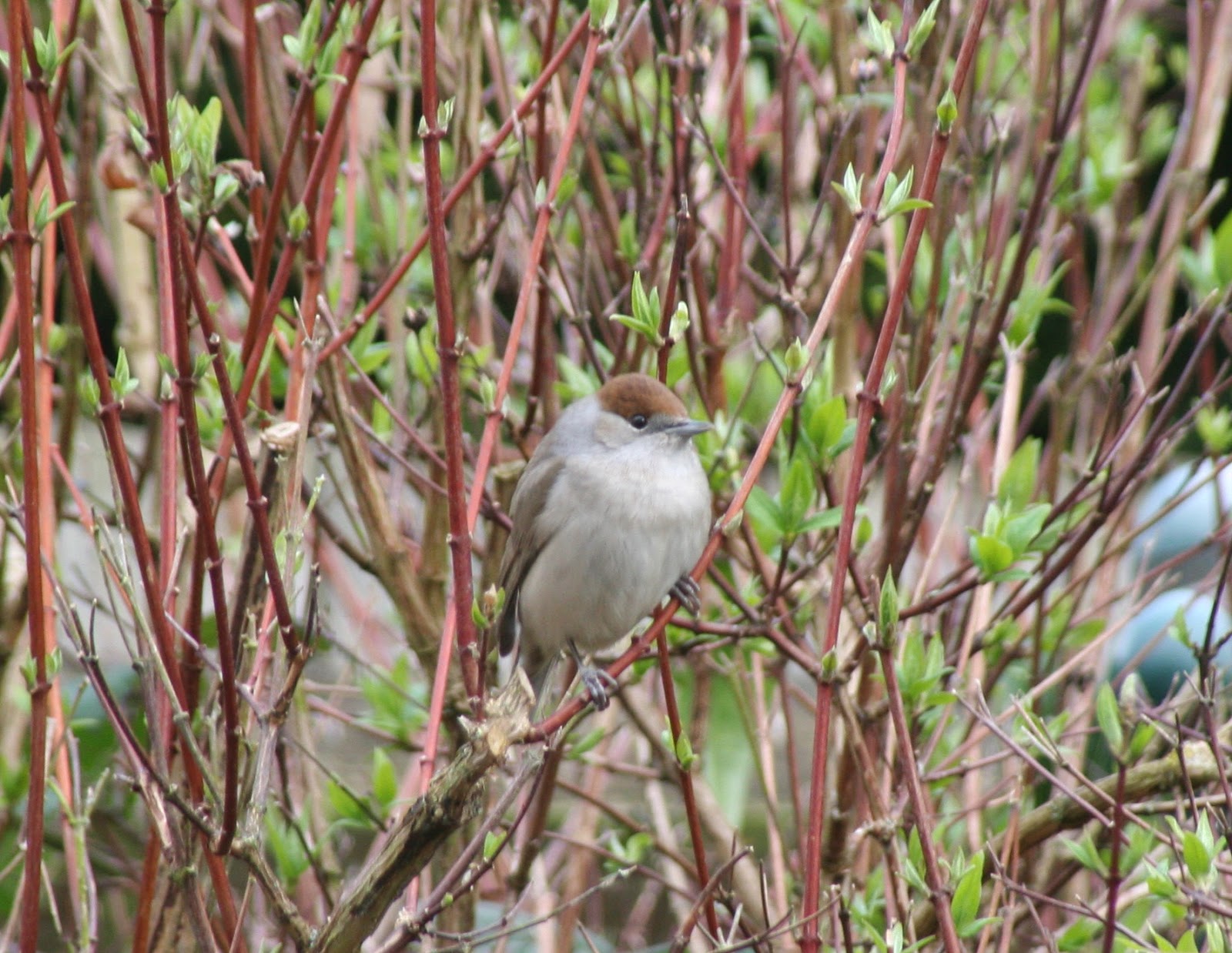
19th Both a male and female blackcap in the garden today.
 Blackthorn blossom
 female blackcap
2 hedgehogs in the garden , one is making lots of hissing noises at the other. I think its the female telling the male she's not ready to mate.

26th A return visit to Somers wood. caravan park.
On the way the clouds are like cotton wool balls in the sky and I see my first swallows of the summer.As we arrive there are blue tits, great tits and chaffinch on the feeders and as we reach our pitch a buzzard fly's over head.
27th We go for a walk in the sun but it soon turns into hail and rain and thunder so we go back to the van.

We fill up the feeder by the van and watch as chaffinch, blue tits, great tits, dunnocks, pigeons, magpies and a nuthatch all feed. 2 robins have a face off on the ground.


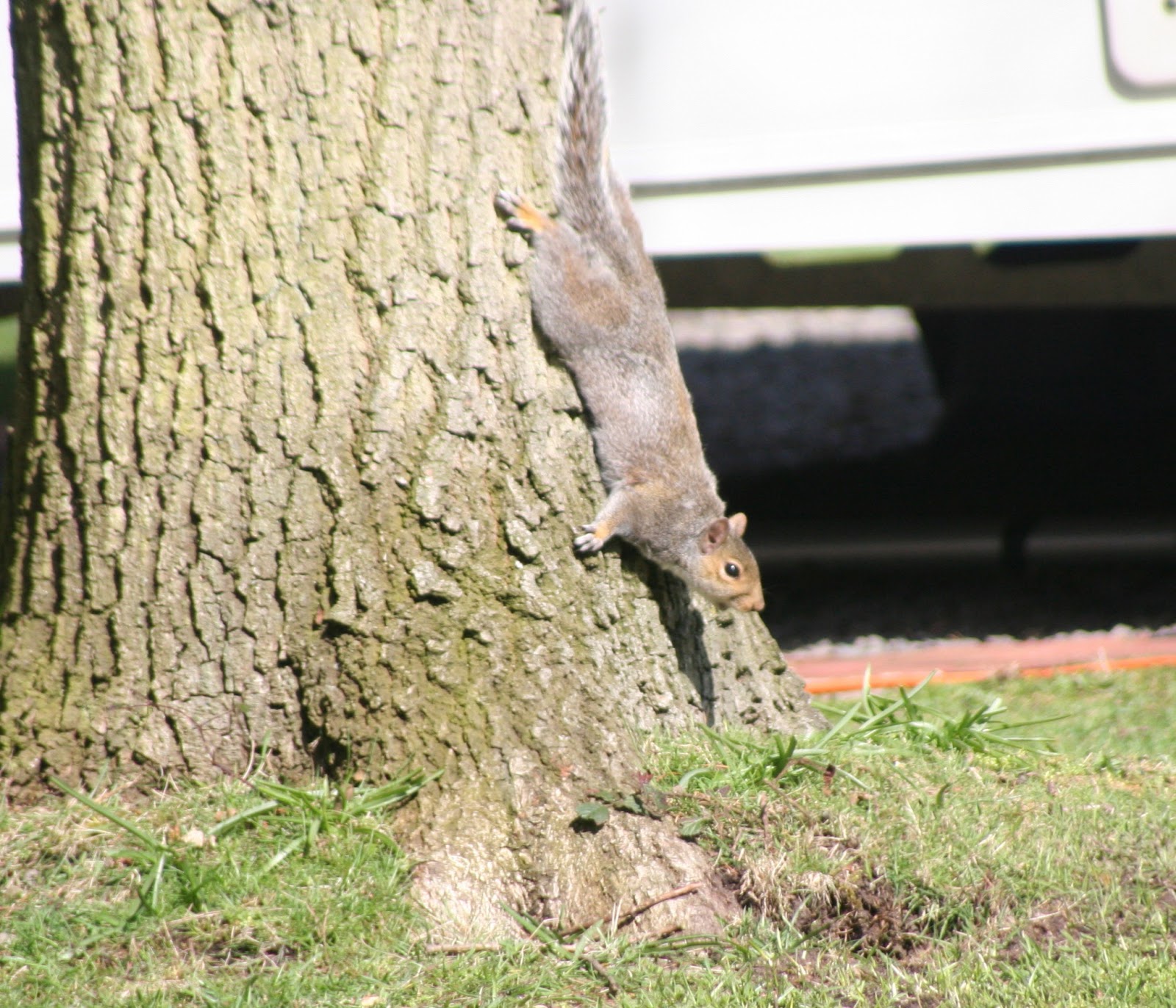
Squirrels and rabbits are close by.


The daffodils are in flower so spring must be here!(about 3/4 weeks late I think). Crocus are flowering in the grass verges and catkins are on the trees.
2nd week.
I thought the blackbird with the white stripe on his wing was the dominant bird but another one has been chasing him off all day. The female has been collecting nesting material from my untidy garden.
13th 3 dunnocks have been flitting around the garden. One of them the female I think has been fluttering her wings at the others. It isn't at all unusual for a female to have 2 males in attendance.
4 goldfinch in the garden today and buds on the trees.
14th Female greater spotted woodpecker feeding in garden today. 1st bee and butterfly of the year. Daffodils and celandine in flower and daisies in the grass. Also blackthorn blossom on the trees.
19th Both a male and female blackcap in the garden today.

2 hedgehogs in the garden , one is making lots of hissing noises at the other. I think its the female telling the male she's not ready to mate.

26th A return visit to Somers wood. caravan park.
On the way the clouds are like cotton wool balls in the sky and I see my first swallows of the summer.As we arrive there are blue tits, great tits and chaffinch on the feeders and as we reach our pitch a buzzard fly's over head.
27th We go for a walk in the sun but it soon turns into hail and rain and thunder so we go back to the van.

We fill up the feeder by the van and watch as chaffinch, blue tits, great tits, dunnocks, pigeons, magpies and a nuthatch all feed. 2 robins have a face off on the ground.


Squirrels and rabbits are close by.

Friday, 8 March 2013
March 2013
1st Saw a goldcrest at dads today, only my third sighting of this tiny bird.
3rd Birds in my garden today, 2 longtailed tits, 3 goldfinch, blackbird ,7 house sparrows, 2 collared doves, 3 pigeons, robins, blue tit, great tit, cole tit and a new spot for me a blackcap.
 The Blackcap is a singing bird,
A Nightingale in melody,
Where Ivy flapping to the breeze,
Bear ring-marked berries black as jet. ... J Clare.
Blackcap (sylvia atricapilla) A bird with a beautiful song but will mimic other birds. In summer it lives in deciduous woodland but can be seen on bird tables in the winter.Feeds on insects, berries and apples. The male builds several nests in brambles or dense vegetation and the female chooses the best and lays 4-5 eggs. They may have 2 broods.
It has been the coldest March for 50 years.
3rd Birds in my garden today, 2 longtailed tits, 3 goldfinch, blackbird ,7 house sparrows, 2 collared doves, 3 pigeons, robins, blue tit, great tit, cole tit and a new spot for me a blackcap.

A Nightingale in melody,
Where Ivy flapping to the breeze,
Bear ring-marked berries black as jet. ... J Clare.
Blackcap (sylvia atricapilla) A bird with a beautiful song but will mimic other birds. In summer it lives in deciduous woodland but can be seen on bird tables in the winter.Feeds on insects, berries and apples. The male builds several nests in brambles or dense vegetation and the female chooses the best and lays 4-5 eggs. They may have 2 broods.
It has been the coldest March for 50 years.
January 2013
Year starts quite sunny which is unusual at the moment.
2nd Andrew startled a blackbird which flew up the road in front at him at 48 mph.
12th Visitors in the garden 4 longtailed tits, 2blie tits, 2 great tits, 2 collared doves, 3 pigoens, 1 magpie and a robin.
13th[14th firtys flurry of snow of the year, filled up the bird table and water.
18th deep snow today 2 fieldfares in the garden. The robins breast looks very red against the snow. a sparrowhawk comes for a meal but misses this time.
8 inches of snow on the ground. 2 fieldfare still eating the apples i'm putting out for them. There are plenty of garden visitors.
 19th A huge icicle hangs from the roof .
 Before I melt, come look at me,
this lovely icy filigree,
of a great forest in one night .
I make a wilderness of white.
2nd Andrew startled a blackbird which flew up the road in front at him at 48 mph.
12th Visitors in the garden 4 longtailed tits, 2blie tits, 2 great tits, 2 collared doves, 3 pigoens, 1 magpie and a robin.
13th[14th firtys flurry of snow of the year, filled up the bird table and water.
18th deep snow today 2 fieldfares in the garden. The robins breast looks very red against the snow. a sparrowhawk comes for a meal but misses this time.
8 inches of snow on the ground. 2 fieldfare still eating the apples i'm putting out for them. There are plenty of garden visitors.


this lovely icy filigree,
of a great forest in one night .
I make a wilderness of white.
October 2012
October starts with mixed weather but there is more of a nip in the air.
2nd Saw a young boy with his dad collecting conkers it brought back memories from both my childhood and my childrens. The leaves are turning to autumn colours.
7th A gang of 7 starlings in the garden, 3 greenfinch, 6 longtailed tits, a great tit, 2 blue tits, a dunnock, 2 pigeons fighting, 2 collared doves, a magpie and a squirrel.
Friday 26th - Wed 31st Bidford - on -Avon
Small CL sight by the river. Lovely autumn colours on the journey. On the very first day we see a kingfisher - He now has a better picture then me.
 2 swans regularly feed on the grass on the river back. as do 4 morehens.
 There is a tangle of dogwood with white berries and red berries near the van where a blackbird and a robin are feeding on the berries. On the feeder I see my first tree sparrow.
 Tree sparrow (passer montanus) Not as common as the house sparrow they have a black spot on their cheeks. Lives in open woodland, farmland, parks and orchards where there are hedgerows. They eat seeds from grasses, cultivated cereals and small invertebrates. It nests in holes and crevices in trees, buildings and cliffs. Both adults build the nest while the female will lay 5 -6 eggs, with 2 - 3 broods a year.
2nd Saw a young boy with his dad collecting conkers it brought back memories from both my childhood and my childrens. The leaves are turning to autumn colours.
7th A gang of 7 starlings in the garden, 3 greenfinch, 6 longtailed tits, a great tit, 2 blue tits, a dunnock, 2 pigeons fighting, 2 collared doves, a magpie and a squirrel.
Friday 26th - Wed 31st Bidford - on -Avon
Small CL sight by the river. Lovely autumn colours on the journey. On the very first day we see a kingfisher - He now has a better picture then me.


Sept 2012
Thursday30th August - Sunday 2nd September
Peatling Magna , the Old Stables, C L site, Leicester.
Quiet sight with views over open fields 2 buzzards circle over the other side of the field. lots of "tits" around visiting the feeder. magpies, crows, pigeons also around while an owl makes itself heard at night.
It has been the wettest summer in 100 years.
The first frost of the year during the night on the 30th August.
10th Saw 2 buzzards in the sky over castle Bromwich.
 11th and 15th there is a fox in dads garden curled up under a bush. Also had a siskin in the garden for the first time.
Peatling Magna , the Old Stables, C L site, Leicester.
Quiet sight with views over open fields 2 buzzards circle over the other side of the field. lots of "tits" around visiting the feeder. magpies, crows, pigeons also around while an owl makes itself heard at night.
It has been the wettest summer in 100 years.
The first frost of the year during the night on the 30th August.
10th Saw 2 buzzards in the sky over castle Bromwich.

Monday, 10 September 2012
August part 3
Minsmere - A smaller wader feeds on the shore line along with the larger birds already mentioned. We are told by another bird watcher that it is a Greenshank.
 Greenshank (tringa nebularia)
A medium- large wader with a slightly upturned bill.Grey above and white below. Feeds by probing into wet mud, pecking at the surface or sweeps bill from side to side. Breeds in sub Arctic but can be found in none breeding season on lakes, estuaries and coastal marshes. Feeds on beetles, worms, snail, small fish, amphibians, shrimps, crabs and ragworms.
Back at the camp sight I took this picture and have called it "beauty and the beast".
 I hope you can see why.
Flowers at Minsmere.


A medium- large wader with a slightly upturned bill.Grey above and white below. Feeds by probing into wet mud, pecking at the surface or sweeps bill from side to side. Breeds in sub Arctic but can be found in none breeding season on lakes, estuaries and coastal marshes. Feeds on beetles, worms, snail, small fish, amphibians, shrimps, crabs and ragworms.
Back at the camp sight I took this picture and have called it "beauty and the beast".

Flowers at Minsmere.

Poppies (papaver rhoeas)
One of my favourite flowers. A tall upright plant with solitary flowers that only last a day.However each plant may produce 400 flowers in a summer. Another name is the corn rose due to its appearance in corn fields. the Roman goddess Ceres was depicted wearing a wreath of poppies. And of course the common poppy grew on Flanders Field after the battles of the First World war and so became the symbol of Remembrance Day.

Corncockle (agrostemma githago)
Rare to find in farmland due to new farming practises. The five broadly overlapping petals are deep pink. the leaves are hairy and very long.

Foxglove (digitalis purpurea)
Foxglove may have got its name from a series of corruptions of old words. The Anglo-Saxon 'gliew' a small bell, and fox could be a corruption of folk's meaning little folk or fairies. In some parts of the British Isles it is called 'fairy bells'. They are a statuesque plant that can bear up to 80 flowers on a single stem. They are very poisonous as it yields the drug digitalis which in small doses is used in the treatment of heart complaints.
August part 2
Still at Minsmere.
At the same hide we saw the Avocet another group of striking birds circles round and eventually lands to feed. Spoonbills.


 Sorry I haven't been able to identify them at the moment but I hope you like the pictures.
At the same hide we saw the Avocet another group of striking birds circles round and eventually lands to feed. Spoonbills.


Spoonbill (platalea leucorodia)
Just a little smaller than the Grey Heron it is still a majestic bird. usually seen on the ground but it will perch in trees. Breeds in coastal marshes and river valleys where there are reeds. Mainly eats insects and their larvae, dragonflies, caddis flies, small fish, amphibians, snails and some vegetation. they do not breed regularly in Britain arriving in April - May, while juveniles arrive July - August. most leave by the end of September.
Still at the same pool another group of white birds were feeding. The Great White Egret.

Egret ( ardea alba)
Another large stately bird almost as big as a Heron. Thousands were killed in the 1800 for the fashion trade. The R.S.P.B. was established to end this mass slaughter. By 2006 over 300 Great White Egret were seen in Britain and figures have continued to rise. It is hoped they will breed in Britain soon. They feed with a harpoon action, standing silently before they strike.
Dragonflies are all over Minsmere zooming past as you walk to the hides. If you are lucky they land for a photo.


Sunday, 9 September 2012
August part 1
More sun and heavy showers starting this month. A squirrel is visiting the garden - I thought the peanuts were going down fast.
3rd Young blackbird in the garden today. for the next few days mainly blackbirds and sparrows in the garden at the moment.
8th 3 young blackbirds in the garden with 2 collared doves. Do you like the picture it made me laugh.
 Friday 10th -Sat18th Suffork. Spent the week at a campsite near Minsmere so daily trips there for the wildlife.
We watch a marsh harrier hunting just above the line of the reeds - under the tree line.


3rd Young blackbird in the garden today. for the next few days mainly blackbirds and sparrows in the garden at the moment.
8th 3 young blackbirds in the garden with 2 collared doves. Do you like the picture it made me laugh.

We watch a marsh harrier hunting just above the line of the reeds - under the tree line.

Marsh Harrier ( curcus aeruginosus)
similar to a buzzard in size the male is paler than the female who is chocolate brown. Often seen hunting low over a reed bed as in the picture. They feed by dropping onto its food from the air, feeds on small birds, ducklings, mammals especially rabbits.
He posses for us on the marker posts before flying off and out of view.
In the island hide we eventually get a good view of a bittern who flies right across the windows to the other side of the hide. He is beautifully golden brown in the sun.

Bittern (botaurus stellaris)
This is a small golden brown heron. It is very secretive and hard to spot until it flies - as I can testify .They live in fresh water, swamps and marshes feeding on fish, eels, amphibians mammals and small birds.
At another hide I get my first sight of an Avocet ,the emblem of the R.S.P.B. A striking black and white bird with an upturned beak sifting to and fro in the water for food.

Avocet (recurvirostra avosetta)
A medium sized black and white wader with a long upturned bill. they are a social species breeding in loose colonies. In England most nest near shallow brackish coastal lagoons. They feed on insects, worms and crustaceans. In 1947 four pairs were found nesting at Minsmere and the R.S.P.B then leased the area.
July part 1
The first week has been awful record breaking rainfall.
7th-9th Dorchester Rain! Rain! and more Rain!. Lots of flooding made it hard to get around. Saw my first live badger trundling along the roadside and a stoat like animal trying to escape the flooding. I have taken some pictures of hedgerow flowers I need to identify later.


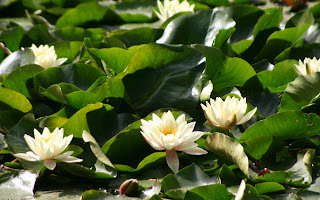
I took this picture of a water-lily on a trip to a local park they were being overflown by dragonflies and damselflies.
7th-9th Dorchester Rain! Rain! and more Rain!. Lots of flooding made it hard to get around. Saw my first live badger trundling along the roadside and a stoat like animal trying to escape the flooding. I have taken some pictures of hedgerow flowers I need to identify later.

Honeysuckle (lonicera periclymenum)
The trumpet flower whose bugles blow scent instead of sound.
Samuel Pepys
Also called woodbine it climbs by coiling around other plants. Herbalists used its flowers for headache potions , lung disease and asthma. Folklore said if honeysuckle was brought into a house , a wedding would follow. The flowers can be added to salads or to decorate desserts. The scent is stronger in the evening and moths can smell it from quarter of a mile away.

Common Mallow (malva sylvestris)
Found on dusty roadsides and waste ground. As early as the 8th century B.C. young mallow shoots were eaten as a vegetable. The Roman Pliny said mallow sap mixed with water gave him day long protection against ache sand pains. In medieval days mallow had a reputation as an anti-aphrodisiac because it promotes clam, sober behaviour. the leaves were also used to relive wasp stings and the sap was used in poultices. The fruit has also been called "billy buttons " and "cheese flower".

Wild Angelica (angelica sylvestris)
a froth of white flowers often tinged with pink, growing in woods or beside streams. Angelica received its name as it was seen as heavenly due to its herbal properties to aid digestion. In the 17th century Nicholas Culpepper recommended it used against "all epidermal disease". He also stated it could be eaten as candy . It is still eaten like this today crystallised for cake decoration.

When we stopped at a lay by for what was a delicious bacon sandwich I spotted this beautiful orchid.
Pyramidal orchid (Anacamptis pyramidalis)
Seen on chalk downland in mid July at their best. The flower has an abundant supply of nectar for both butterflies and moths. The scent has musky overtones.
On another outing in the caravan we see lots of the usuals -pigeons, rooks and 11 thrushes in the field - the most I've ever seen in one go.
The weather all month has been either sun or heavy rain. All the usuals in the garden, great tits, blue tits, goldfinch, sparrows, blackbirds.

White water-Lily (nymphaea alba)
For poets the flower of the white water-lily was a symbol of purity of the heart. It is the largest flower in British flora. In Cheshire it is called the "lady of the lake". In Whiltshire and Dorset "swan amongst the flowers". The flowers are on stems up to 9ft long.
June part 3
4th We went to the live feed to see the Osprey on the nest and saw the chick. Later that day we go for a walk along the banks of the lake and WOW the male osprey flew around fishing. It was breathtakingly beautiful and just what we had come to see. He dived a couple of times before being successful and taking his catch back to the nest.

Osprey (pandion haliaetus)
Generally seen alone except at the nest sight. Often perches on dead trees in the feeding area. In flight its body and wings are larger than a buzzard and its wings appear kinked at the joint. The body has white underparts with a brown breast band. The vast majority of food is fish but will also eat small mammals, reptiles and amphibians. They leave their breeding grounds in mid August and head south, arriving in Africa in late September.
5th It was so wet today a couple of oystercatchers and mallards are feeding on the field the caravan is in.
6th More osprey action as we returned to the lake. The female flew passed us carrying a fish away from the nest sight with the male screeching above her and following. They both returned later still carrying the fish.
A great week bird spotting.
10th 2 young great tits in the garden, young blue tit, goldfinch and young starlings. The hedgehog came around 7pm.
15th Several young birds in the garden today- blackbird, collard dove, bluetit, great tit , goldfinch- it is still very wet!
19th Poem
21st Jay again but too fast for a photo. A greenfinch visits as does a pair of chaffinch sing beautifully in the tree. Both rare in my garden. The weather is still yuk!
27th Weather - beautiful at last. Glad to see the greenfinch and chaffinch again. The Jay came again and after an absence the cole tit has returned. No sign of the hedgehog for 3 nights.
28th Thunderstorm and torrential rain. I 've never seen the river so high.
30th It's been the wettest April - June since records began,

Osprey (pandion haliaetus)
Generally seen alone except at the nest sight. Often perches on dead trees in the feeding area. In flight its body and wings are larger than a buzzard and its wings appear kinked at the joint. The body has white underparts with a brown breast band. The vast majority of food is fish but will also eat small mammals, reptiles and amphibians. They leave their breeding grounds in mid August and head south, arriving in Africa in late September.
5th It was so wet today a couple of oystercatchers and mallards are feeding on the field the caravan is in.
6th More osprey action as we returned to the lake. The female flew passed us carrying a fish away from the nest sight with the male screeching above her and following. They both returned later still carrying the fish.
A great week bird spotting.
10th 2 young great tits in the garden, young blue tit, goldfinch and young starlings. The hedgehog came around 7pm.
15th Several young birds in the garden today- blackbird, collard dove, bluetit, great tit , goldfinch- it is still very wet!
19th Poem
8 starlings come in fighting ,crashing.
while 4 blue and great tits arrive on silent wings.
3 goldfinch twitter their arrival,
while 3 blackbirds call a single note as they feed.
A robin comes and tuts while bobbing.
The sparrows cheep and chirp in the tree.
The dunnock is as quiet as a mouse,
while the pigeon blunders about.
The hedgehog visits around 8
And a jay flies in much to my surprise.
This is the story of this sunrise.
.P. Beach
27th Weather - beautiful at last. Glad to see the greenfinch and chaffinch again. The Jay came again and after an absence the cole tit has returned. No sign of the hedgehog for 3 nights.
28th Thunderstorm and torrential rain. I 've never seen the river so high.
30th It's been the wettest April - June since records began,
June part 2
3rd Another overcast day. Set out to see the Osprey. After a major trek up the side of a hill we came to the first viewing point. Sadly disappointing all we could see was a white blob on the nest (the female). Also saw 4 herons , a greater spotted woodpecker, jay, cole tits and a wren.
The higher view point was another major trek away but the views were better. The male had come to join the female- sitting on top of the dead tree the nest was in. Both were still small through the scope.

The higher view point was another major trek away but the views were better. The male had come to join the female- sitting on top of the dead tree the nest was in. Both were still small through the scope.
Osprey
On a gaunt and shattered tree.
By the black cliffs of obsidian
I saw the nest of the Osprey.
Nothing remained of the tree.
For this lonely Eyre
Save the undaunted bole
That cycles of the wind has assaulted
And clinging still to the bole,
Tenacious the top most branches.
Here to scan the heavens,
Nested the Osprey.
Jessie B. Rittenhouse
The female has been here since 2000, the male is new this year and is her son from 3 years ago. 3 eggs were laid but only one has hatched. The nest is the size of a double bed and lined with moss. The first they built was blown down so a new platform was put up for them.


That night the mountains turned from black to red in the setting sun, only to turn black again when the sun had set.

June part 1
Sat 2nd Diamond Jubilee weekend. Herdwick Croft, Caravan Park, Bassenthwaite, Cumbria.
Beautiful views of some of Cumbria's mountains from the camp site. We took a walk down by the lake in the evening and were entertained by a flock of swallows feeding over the water. A "V" of geese flies high over the hills which are shrouded in clouds, wild garlic and ragged robin grow on the shore under the canopy of trees whose trunks are all covered in moss.

Ragged Robin ( lychnis flos-cuculi) . Bringing a splash of colour to marshes. wet meadows and damp woodland throughout Britain . Although the flowers are usually pink, white flowers can also be found. The plant has tall, slender flowering stems. Flowers from May - June. Like buttercups and marsh marigold they are also known as bachelor's buttons as country girls believed if they picked several flowers at the same time, giving each a name and put them in their apron, the first to flower would be that of their future husbands. Children called them thunder flowers as they believed picking them would make it thunder and lightening.
Beautiful views of some of Cumbria's mountains from the camp site. We took a walk down by the lake in the evening and were entertained by a flock of swallows feeding over the water. A "V" of geese flies high over the hills which are shrouded in clouds, wild garlic and ragged robin grow on the shore under the canopy of trees whose trunks are all covered in moss.

Ragged Robin ( lychnis flos-cuculi) . Bringing a splash of colour to marshes. wet meadows and damp woodland throughout Britain . Although the flowers are usually pink, white flowers can also be found. The plant has tall, slender flowering stems. Flowers from May - June. Like buttercups and marsh marigold they are also known as bachelor's buttons as country girls believed if they picked several flowers at the same time, giving each a name and put them in their apron, the first to flower would be that of their future husbands. Children called them thunder flowers as they believed picking them would make it thunder and lightening.
May part 2
18th Young starlings in the garden - the first young of the year.
19th On a trip to a friends I see my first flock of swallows of the year and a fox trotting along by the river on the way home.
20th 5 fledgling starlings in the garden. The male robin is feeding the female, part of a mating ritual. A chaffinch feeds on the ground, a rare visitor to the garden so this is a special treat.
26th The swallows were right the summer seems to have arrived the last few days have been beautiful.
The hedgehog has been coming to visit around 6pm going into the undergrowth and reappearing about 9pm.
28th A visit up to Bedford and a beautiful silvery, white and black pheasants tail disappears into a hedgerow. We stop the car and the female shows up. It is new to me a Lady Amherst's Pheasant

Lady Amherst's Pheasant ( chrysolophus amherstiae)
Native to South Western China and Myanmar but have been introduced elsewhere. They have established a self-supporting but now declining feral population in Bedford England. The male is 100-12 cm in length, his tail 80cm in length is unmistakable with its black and silver pattern that matches the cape around his head. It has red, blue,white and yellow body plumage. The cape can be raised in display. They feed on grain, le3aves and invertebrate's. At night they roost in trees.
Later the same day we see a Green Woodpecker feeding on the ground by the side of the road. Another first its been quite a day.

19th On a trip to a friends I see my first flock of swallows of the year and a fox trotting along by the river on the way home.
20th 5 fledgling starlings in the garden. The male robin is feeding the female, part of a mating ritual. A chaffinch feeds on the ground, a rare visitor to the garden so this is a special treat.
26th The swallows were right the summer seems to have arrived the last few days have been beautiful.
The hedgehog has been coming to visit around 6pm going into the undergrowth and reappearing about 9pm.
28th A visit up to Bedford and a beautiful silvery, white and black pheasants tail disappears into a hedgerow. We stop the car and the female shows up. It is new to me a Lady Amherst's Pheasant

Lady Amherst's Pheasant ( chrysolophus amherstiae)
Native to South Western China and Myanmar but have been introduced elsewhere. They have established a self-supporting but now declining feral population in Bedford England. The male is 100-12 cm in length, his tail 80cm in length is unmistakable with its black and silver pattern that matches the cape around his head. It has red, blue,white and yellow body plumage. The cape can be raised in display. They feed on grain, le3aves and invertebrate's. At night they roost in trees.
Later the same day we see a Green Woodpecker feeding on the ground by the side of the road. Another first its been quite a day.

Laugh, woodpecker, down in the wood.
A. C. Brown
Green Woodpecker ( picus viridis) Mainly found in open deciduous woodland, parkland, orchards, farmlands, healths and conifer woods. Often feeds on grassy pasture where it finds ants nests. Feeds on insects with its sticky tongue. Also eats eggs, larvae, beetles, flies and caterpillars. Its used to be called "Yaffle" due to its laugh. Also known as "Rainbird" due to his song being heard in April the rain month.
Monday, 2 July 2012
May 2012 part 1
May is starting sunshine and showers. Dandelions are in full bloom. Dandelions are part of nature's medicine cabinet. The vitamin A and iron rich leaves are at their best in spring and can be added to salads along with the flower buds. The roots can be used in stir-fries. traditionally used to treat liver problems as the plant has a diuretic effect so will help the body expel excess fluid.
On a wildlife note Twits rely heavily on their seeds to eat.
5th arrived home and tried to open the gate only to find the hedgehog was behind it! I left her some food and after time she ate it all up.
6th This morning the hedgehog is asleep between our bins.

Sunny today 4 starlings making lots of noise in the garden, 4 goldfinch on sunflower seed and niger seed, great tits and blue tits visit, dunnocks, sparrows and robins also here.
12th /13th Beautiful weekend watching all my usuals visiting the garden. A pair of sparrows are mating in the blossom tree and stay most of the afternoon. At 9:40 2 Bats fly overhead the bat detector was on 43khz. the hedgehog appeared at 10pm.
On a wildlife note Twits rely heavily on their seeds to eat.
6th This morning the hedgehog is asleep between our bins.

Sunny today 4 starlings making lots of noise in the garden, 4 goldfinch on sunflower seed and niger seed, great tits and blue tits visit, dunnocks, sparrows and robins also here.
12th /13th Beautiful weekend watching all my usuals visiting the garden. A pair of sparrows are mating in the blossom tree and stay most of the afternoon. At 9:40 2 Bats fly overhead the bat detector was on 43khz. the hedgehog appeared at 10pm.
Monday, 21 May 2012
April 2012 part 5
Still at the caravan park. Saturday afternoon the rain subsided a little so we went for a walk in the wood. Our first spot was a tree creeper flying to the bottom of the tree and moving upwards while spiralling round the trunk probing the bark for food. It uses its tail to steady itself.
 Tree Creeper (Certhia familiaris) Generally it is a solitary but will flock together with other small birds. It breeds in coniferous and deciduous woods throughout Britain and Ireland. Living on a diet of insects and seeds.

Tree Creeper
Mouse up a tree,
White belly
Close to the bark,
Curved bill
And tail support.
Robin Ivy
Subscribe to:
Posts (Atom)